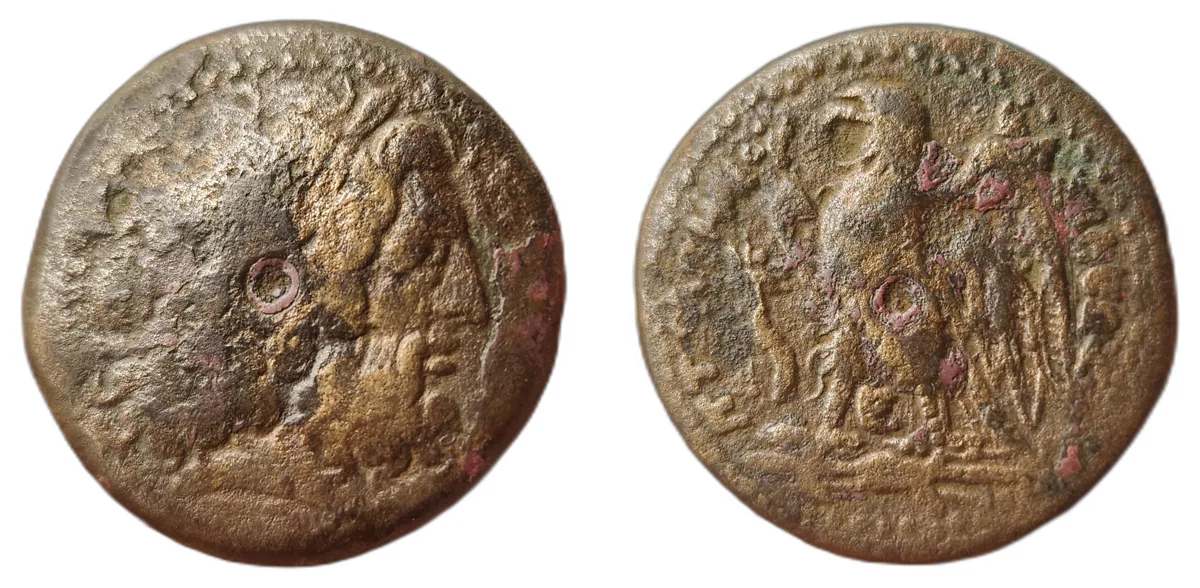
Ptolemy III Euergetes - 10.22 g AE 28 - Obo
Sold by NathanielsCreativeCollections
Description
Ptolemaic Egypt is best known for its massive bronze coinage, with some issues among the largest bronze coins struck in antiquity. These large denominations served as practical, high-value currency within Egypt's relatively closed monetary system. The kingdom also produced smaller fractional bronzes such as this obol, which represented the more practical end of the same monetary system, although this example is struck on an unusually large flan for its denomination.
This obol was struck at Alexandria between 246 and 222 BC under Ptolemy III Euergetes, who expanded Ptolemaic power to its territorial height through his victories in the Third Syrian War. The obverse depicts the laureate head of Zeus facing right, wearing a plain laurel wreath without the ram's horn associated with the Zeus-Ammon type. The reverse shows an eagle standing left on a thunderbolt with its head turned left and wings spread, accompanied by a filleted cornucopia in the left field and an Epsilon between its legs, together with the inscription ΠΤΟΛΕΜΑΙΟΥ ΒΑΣΙΛΕΩΣ ("of King Ptolemy"). The unusually large 28 mm flan makes this an oversized-flan variant. It is catalogued as a variant of Svoronos 976 and compared with SNG Copenhagen 234.
Obverse: Laureate head of Zeus right, plain laurel wreath, no ram's horn
Reverse: Eagle standing left on thunderbolt, head left, wings open/spread, filleted cornucopia in left field, E between legs; ΠΤΟΛΕΜΑΙΟΥ ΒΑΣΙΛΕΩΣ ("of King Ptolemy")
Catalogues: Cf. Svoronos 976 (E var.); Cf. SNG Copenhagen 234
Mint Info: Alexandria, 246–222 BC
Mass: 10.22 g
Diameter: 28 mm