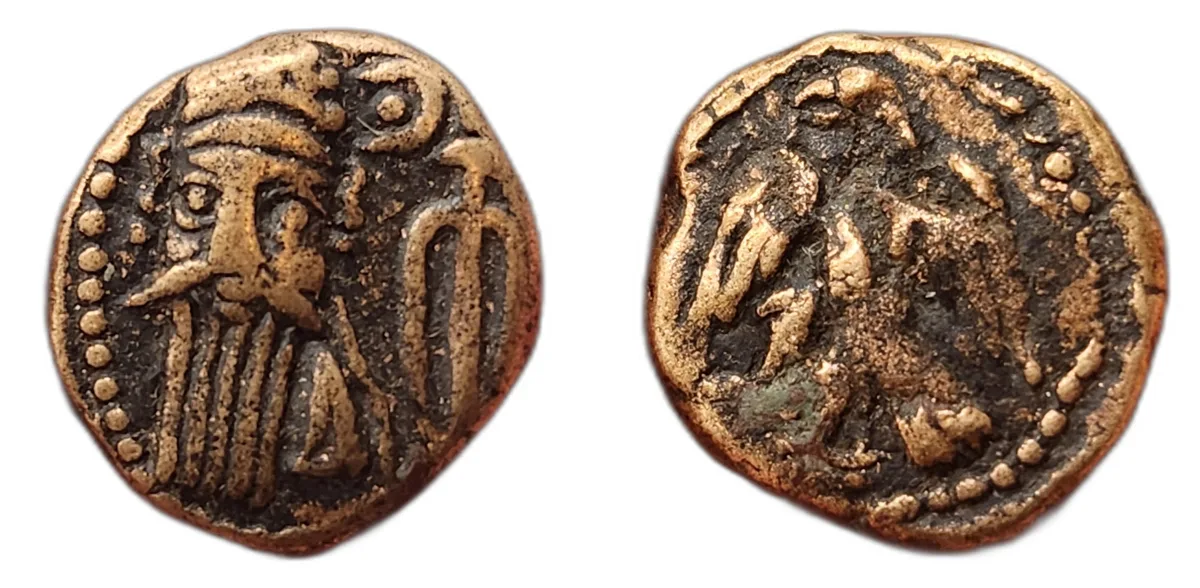
Elymais Drachm — Phraates — Eagle
Sold by NathanielsCreativeCollections
Description
Kings of Elymais
Ruler: Phraates
Period: Early to mid-2nd century AD
Denomination: AE Drachm (2.16 g; 13 mm)
Mint: Susa
Obverse: Diademed bust facing, wearing tiara; star-in-crescent above inverted anchor with one crossbar at bottom
Reverse: Eagle with wings spread standing left
Numismatic Type: —
Elymais was an ancient kingdom located in the mountainous region of southwestern Iran, centered around the ancient city of Susa. Although overshadowed in popular history by Rome, Greece, and Byzantium, Elymais occupied a strategically important position between Mesopotamia and the Iranian plateau. The kingdom emerged as a significant regional power during the Hellenistic and Parthian periods and maintained a distinctive cultural and political identity for centuries. Its coinage reflects this fascinating position at the crossroads of Greek, Iranian, and Mesopotamian traditions, combining royal portraits and symbols of local authority with imagery inherited from the broader Hellenistic world.
Phraates ruled Elymais during the early to mid-2nd century AD, a period in which the kingdom operated within the wider political world dominated by the Arsacid Parthian Empire. Like many Elymaean rulers, relatively little is known about Phraates from surviving literary sources, making his coinage particularly important for understanding his reign and the political identity of the kingdom. His coins preserve the distinctive royal imagery of Elymais, including the diademed ruler wearing the characteristic tiara and the religious and dynastic symbols associated with the Elymaean monarchy.
This small bronze drachm was struck at Susa and features a particularly distinctive obverse design. The facing, diademed bust of the king wears a tiara, while a star-in-crescent appears above an inverted anchor bearing a single crossbar. The reverse depicts an eagle standing left with its wings spread. The eagle was a powerful symbol throughout the ancient Near East and Hellenistic world, and its presence here gives the coin a striking visual connection to the wider traditions of ancient royal coinage. At only 13 mm and 2.16 g, this compact bronze nevertheless preserves a remarkable amount of information about the ruler, religious symbolism, and artistic traditions of the lesser-known kingdom of Elymais.