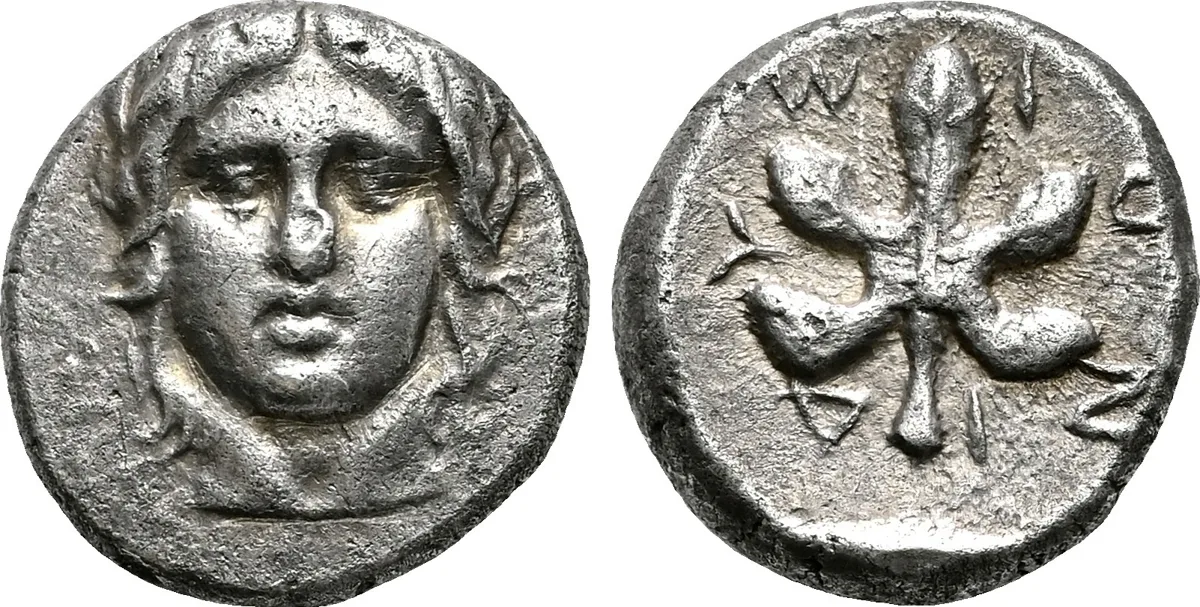
Caria, Idyma, drachm, 400/380 BC, facing head of Pan
Sold by Facinghead_Collection
$1,900.00
Description
obv. Head of horned Pan facing
rev. I-Δ-Y-M-I-O-N around fig leaf within incuse square
A slight scuff on the nose and some scratches on the right eye.
Ex: Peus Nachf., auction 439, 2024, 1223 and auction Gorny & Mosch 265, 2019, 409.
The first recorded mention of Idyma (located at the northern end of modern Gökova, Turkey) was in 546 BC as a member of the Attika-Delos Sea Union founded against the Persians with the leadership of Athens. The town was located at the head of the Ceramic gulf. In the year 546 BC, Idyma has been occupied by the Persian army, under the command of Harpagos. From 484 – 405 BC, the Persian regiment has been banished and the city participated in the Attica Delos Sea Union lead by Athens. Idyma became a member of the Union by paying 1 Talent and 890 drachmas in taxes. Idyma is mentioned in the tax lists for the years 453-452 BC, the earliest written document on the city. The same reports mention a local sovereign by the name of Paktyes, whose descendants may have founded a dynasty which governed Idyma and to whose members the rock tombs could be attributable. In the fifth and fourth century BC. Idyma produced its own coins, one side of which was marked with the name Idymion, and the other side with the head of Pan, hinting at a shepherd′s cult. From 167 BC to at least the 2nd century AD, Idyma, together with the entire region south of Muğla (Mobolla) was part of the Rhodes′ mainland possessions (Rhodian Peraia).
In ancient Greek religion and mythology, Pan is the god of the wild, shepherds and flocks, rustic music and impromptus, and companion of the nymphs. He has the hindquarters, legs, and horns of a goat, in the same manner as a faun or satyr. With his homeland in rustic Arcadia, he is also recognized as the god of fields, groves, wooded glens, and often affiliated with sex because of this, Pan is connected to fertility and the season of spring. Being a rustic god, Pan was not worshipped in temples or other built edifices, but in natural settings, usually caves or grottoes such as the one on the north slope of the Acropolis of Athens. These are often referred to as the Cave of Pan.