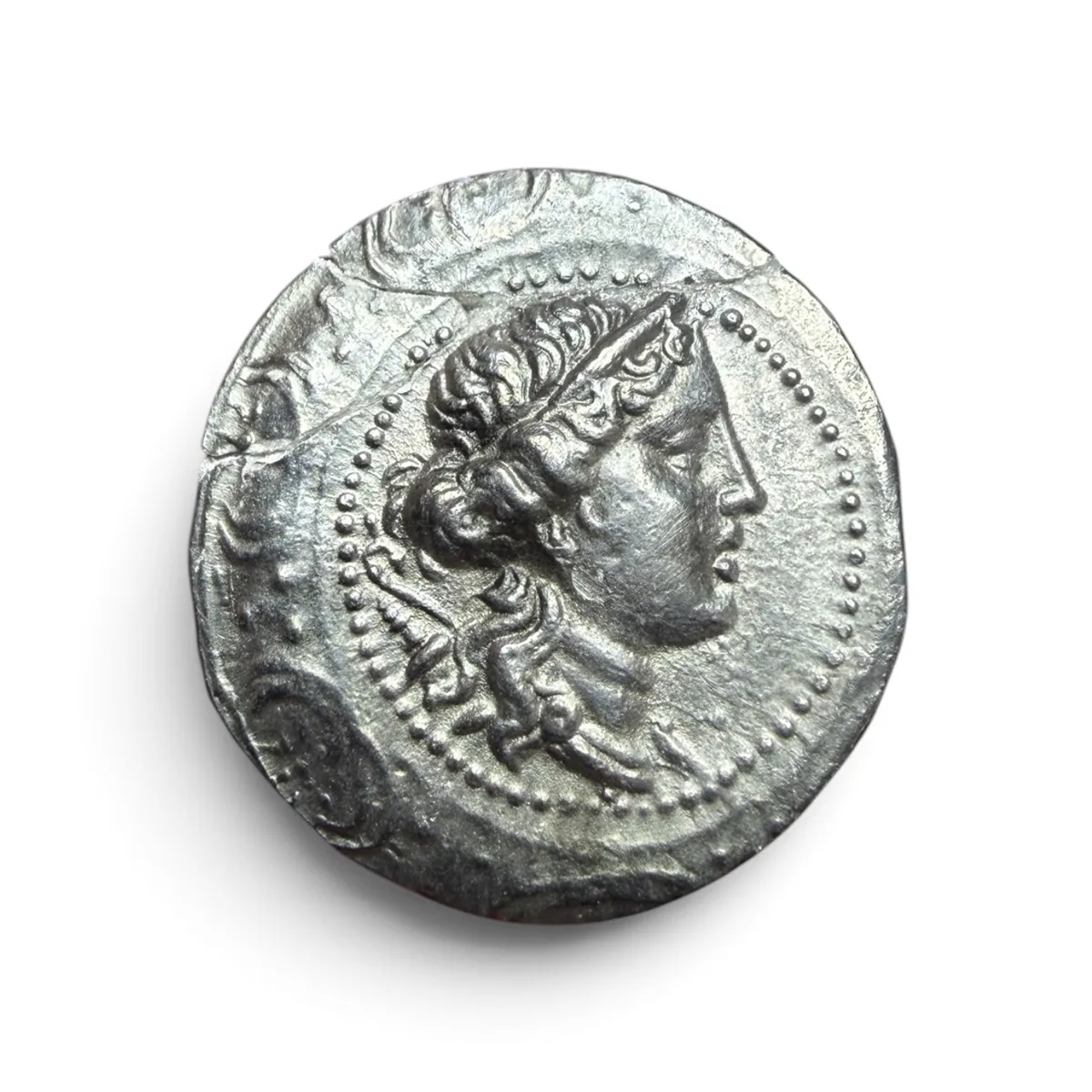
Macedon under Roman Protectorate – First Meris (district)
Sold by Classiccoins.inc
$500.00
Description
Macedon under Roman Protectorate – First Meris (district)
• Date: circa 167–148 BC (struck after the Battle of Pydna, 168 BC)
• Mint: Amphipolis
• Denomination: AR Tetradrachm, approx. 16.6–16.9 g, 31–33 mm
• Obverse: Diademed and draped bust of Artemis Tauropolos right, bow and quiver over shoulder; all in the center of a Macedonian shield decorated with stars and pellets 
• Reverse: MAKEΔONΩN / ΠPΩTHΣ around a horizontal club of Herakles; within an oak wreath, thunderbolt to left, monogram(s) above and below (yours shows AP above) 
• Standard references: SNG Copenhagen 1310–1321; HGC 3.1, 1103; AMNG III/1, 155 
Translation of the legend: "Of the Macedonians, the First" — the first of the four Roman client districts.
Conservation Report
Condition on receipt: Broken into three main fragments with additional microscopic edge losses. Severe horn-silver (silver chloride) crystallization with active flaking and lamination — a well-known vulnerability for these Amphipolis tetradrachms.
Treatment performed (August 2026):
• Dry mechanical cleaning only — no acids, electrolysis, or polishing
• Pre-consolidation of friable surfaces with Paraloid B-72 at 5% w/v in acetone
• Structural re-joining of fragments with Paraloid B-72 at ∼45% w/w in acetone, applied under binocular magnification
• No fill material, no inpainting, no irreversible adhesives used
Materials: Paraloid B-72 (ethyl methacrylate / methyl acrylate copolymer) — museum-standard, fully reversible with acetone.
Result: Coin is now structurally stable and legible on both sides. Join lines remain visible under magnification, as is correct conservation practice. All treatment is reversible.
Storage recommendation: Keep dry (<50% RH), in an inert holder (Mylar or Saflip, not PVC), with silica gel. Avoid handling the joins; if future stabilization is needed, re-treat with acetone only.