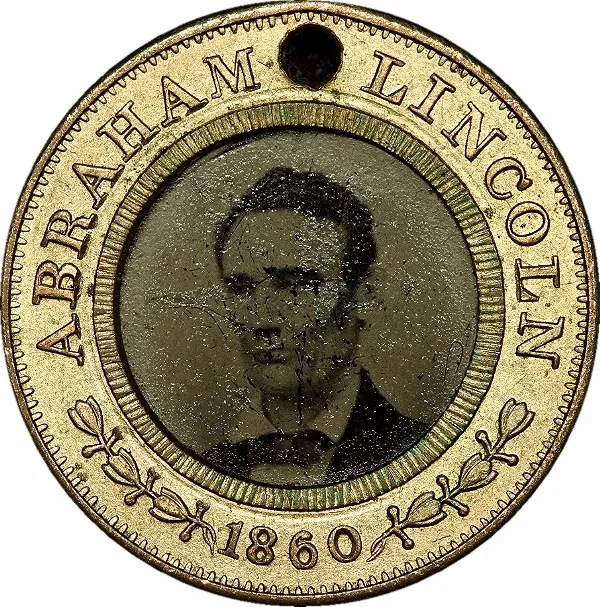
Exonumia, 1860, Cunnigham 2-260B, DeWitt-AL 1860-91, Token, CH. BU
Sold by Harlan J. Berk, Ltd.
$1,500.00
Description
Exonumia, 1860-Token, CH. BU, Cunnigham 2-260B, DeWitt-AL 1860-91.
Introduced in Paris in 1853, the ferrotype, or “tintype,” revolutionized photography. Produced by creating a direct-positive image on a thin sheet of iron coated with dark lacquer and a photographic emulsion, the process made portrait photography inexpensive, portable, and accessible to the masses.
The human drama of the American Civil War brought the technology to new heights of popularity, and ferrotypes became one of the most recognizable photographic formats of the era. Political campaigns quickly recognized the potential of this new medium. For the first time, candidates could quite literally put their faces into the hands of voters.
The present example, featuring Abraham Lincoln and his running mate Hannibal Hamlin, dates to the historic presidential election of 1860. Here we see a young, beardless Abraham Lincoln, not yet burdened by the terrible weight of civil war. His appearance stands in stark contrast to the deeply lined, hollow-eyed, war-weary president whose image has become so familiar to generations of Americans.
These remarkable pieces are survivors of both political and photographic history. The delicate ferrotype portraits were particularly susceptible to scratches, corrosion, and outright destruction, and many surviving campaign tokens have lost one or both portraits entirely.
The present example retains both portraits remarkably well and is among the most complete and visually striking examples we have encountered in the last decade.
A tangible reminder of an election that would forever change the course of American history.