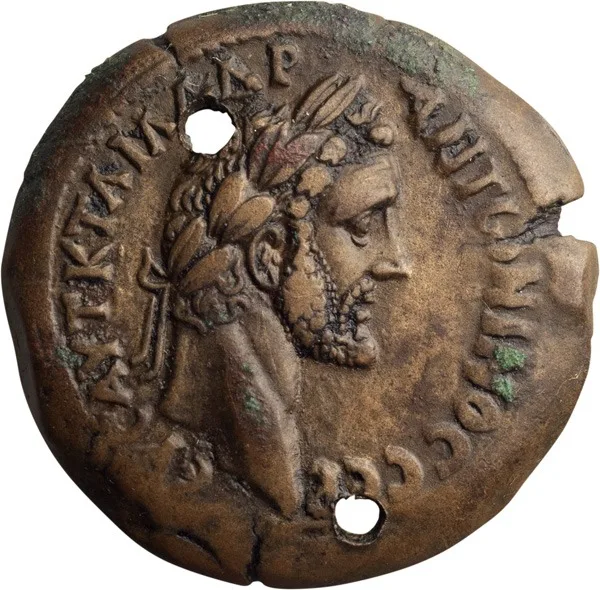
Antoninus Pius. Drachm
Sold by Harlan J. Berk, Ltd.
$31,500.00
Description
Antoninus Pius; 138-161 AD, Alexandria, Egypt, Dated 143/4 AD, Drachm, 21.33g. RPC-IV.4, 685 (this coin depicted), Dattari/Savio-2998, Emmett-1635.7. Obv: ΕΥϹ ΑΥΤ Κ Τ ΑΙΛ ΑΔΡ-ΑΝΤѠΝΙΝΟϹ ϹΕΒ, Laureate head r. Rx: L-Ζ, The Judgement of Paris: Aphrodite, Hera, and Athena standing on raised platform, being judged by Paris while Hermes sits beside him; animals recline in front of the platform, while two Erotes hold a wreath above Venus' head. The myth of the Judgment of Paris serves as the inciting incident for the Trojan War. Eris, goddess of discord, was excluded from a wedding attended by all the gods and decided to gatecrash anyway. In retribution for being snubbed, she lobbed a golden apple inscribed "for the fairest" into the midst of the goddesses. Hera, Athena, and Aphrodite each claimed the apple, and Zeus, being the god of judgement, was asked to decide the winner. Caught between his wife, daughter, and daughter-consort-sister (the nature of their relationship varies from myth to myth) Zeus, understandably, appointed the mortal Paris as judge instead. Each goddess offered Paris a bribe: Athena offered him martial skill, Hera dominion over nations, and Aphrodite the most beautiful woman in the world, Helen of Sparta. Even though Helen was the wife of the Greek king Menelaus, Paris claimed his prize, absconded to Troy with Helen, and set into motion the events of the Trojan War.
This double-pierced drachm has been identified by CNG as a funerary token for a Romano-Egyptian mummy: "Coins and other amulets were woven into the fabric of the mummies to serve as talismans against the spirits that would try to harm them on their way to the afterlife, the coin would pay the toll to Charon, the Greco-Roman tradition of paying the ferryman, which had been absorbed into Egyptian customs." The specimen depicted in Dattari 2998, pl. XXVI is similarly pierced with two holes and may have been used in the same way.
Ex CNG Triton XXVI, Jan. 2023, lot 584; Ex Naville 64, Mar. 2021, lot 267.Though this is one of the very last coins in our catalogue, it is one of the most important. Quite rare, this is probably the finest example of this issue, showing the inciting incident of the Trojan War. It is also connected to an important ritual in Roman Egypt: the two pierced holes indicate it was placed and buried with a Roman mummy. This shows the degree of religious and cultural syncretization of Greek, Roman, and Egyptian societies that existed in Roman Egypt at the time. One the finest examples of the Judgement of Paris in existence.
Provenance: Ex CNG Triton XXVI, Jan. 2023, lot 584; Ex Naville 64, Mar. 2021, lot 267