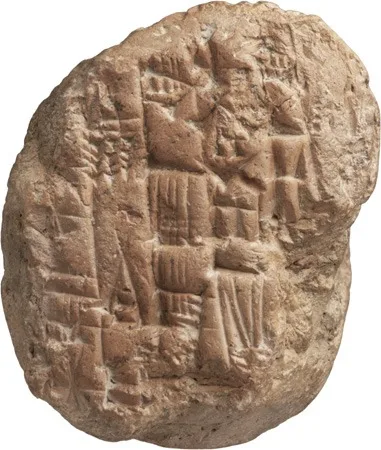
Sumerian Cuneiform Tablet
Sold by Harlan J. Berk, Ltd.
Description
Sumerian Cuneiform Tablet, ca. 3rd-2nd Millennium BC. Sumer, ca. 1953-1935 BC. Conical clay tablet with cuneiform inscription around the front of tablet. Inscription continues on top of cone, which is very rare for cone tablets.
The cone inscribed with a building inscription in the name of Ishme-Dagan, kins of Isin (1955-1937). It is identical to a cone in the Schoyen collection published by A.R. George in Cuneiform Royal Inscriptions and Related Texts in the Schoyen collection, CLD Press, Bethesda, MD, 2011:89-91. The test is in the Akkadian language, unlike Ishme-Dagan's other building inscriptions, which employ Sumerian; the text continues from the head to the shaft, and the latter is divided into two columns whose lines are perpendicular to its long axis, instead of parallel.
The building whose construction is recorded on this cone is a defensive wall comprising an earthen rampart anmd a ditch (ikum) beyond it. Ishme-Dagan is known to have constructed or restored two city walls: that of Isin, his capital, and that of Durum, a garrison town near Uruk. The former wall is the subject of a well-known cone inscription in Sumerian. Ishme-Dagan's work on Durum's wall is recorded in a Sumerian inscription written twice, once on the head and again on the shaft., on asingle clay nail first published in 1937 (Frayne 1990: 42 E4.1.4.11). The present text exhibits a similarity of structure with the latter, especially, but, if line 22 is understood as containing a toponym, it reports a different geographical location.
The inscription is also important for its detailed metrology, in a passage which gives two measurements for the width of the wall's ditch, first in nindan "rod" (the twelve-cubit measure, ca 6 m) and again in another unit, previously unattested. The inscription ends in an unexplained repetition of nindan, from which it appears that the text is devective or unfinished.
1 d ish-me-dda-g[an]
2 za-ni-in
3 nippuru(nibru)ki
4 tu-ku-ul-ti
5 /urim5/ ki
6 [a-she-er]
7 [eridu(NUN)ki]
shaft col. i
8. na-tsi-i[r]
9 mi-i
10 [uruk(unug)]ki
11 [mu-ut esh4]-tár
12 [e]-lum
13 /dshamash(utu) ì/-si-inki
14 shar shu-me-ri-im
15 ì-lí
16 ma-at
17 /wa/-[ri]-/im/
18 [ta-li-im]
19 [den-líl]
20 [dish-me-dda-gan]
21 [sha-dú-ri-im]
22 [sha? na?-aZ-na-an-ni -im]
23 [e-pé-ri-sh]u?
shaft col. ii
24 ki-i!ma!(AB) sha-dì-[im]
25 ú-sha-ash-pí-ik
26 i-kà-am
27 shi-na ù mi-ish-lam
28 i-na / /ni-in-da-an-ni-im
29 ru-pu-ush-shú
30 esh-re-et
31 /i-na/ [we-e]-/li-im/
32 [ra-pa-ash]
33 [mu-úsh-ra]
34 [ù-sí-ir-shu]