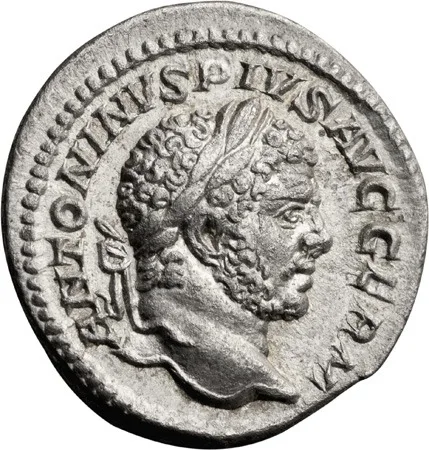
Caracalla. Denarius
Sold by Harlan J. Berk, Ltd.
$4,400.00
Description
Caracalla; 198-217 AD, Rome, c. 206 AD, Denarius, 4.13g. C-626; BMC-p. 261, g; RIC-171. Obv: ANTONINVS - PIVS AVG Head laureate r., unbearded. Rx: VICTORIAE AVGVST Victory, naked to waist, seated r. on low seat, placing l. hand atop shield resting on column before her and holding parazonium at her side in r. hand; below seat, cuirass lying sideways on ground.
Ex Curtis L. Clay Collection; ex CNG 85, 15 Sept. 2010, lot 947.
An exceptional type, known so far only for Caracalla (though perhaps a pendant for Septimius should be expected), and only on denarii, not on aurei or bronze coins too. The abbreviation AVGVST rather than AVGG or AVGVSTORVM in the reverse legend is unusual; likewise the tipped-over cuirass and the fact that Victory holds a parazonium rather than a writing utensil to inscribe her shield. Cohen-626 originally reported a specimen of this denarius from Imhoof-Blumer's collection in 1886, and Imhoof's coin was later sold, though without illustration, in J. Hirsch XVIII, 27 May 1907, Imhoof-Blumer, lot 1148 (graded "schön", the equivalent of today's "VF" or "Good VF"; weight not given). Now Imhoof-Blumer, Cohen=Feuardent, and Jacob Hirsch were eminent authorities, but in the absence of an illustration they were unable to persuade later numismatists of this coin's regularity: Pink in his Aufbau considered it doubtful, Mattingly in BMC listed the type as "uncertain" and repeated Pink's "doubtful", B.A. Seaby left it unpriced in his Roman Silver Coins, and P.V. Hill omitted the type from his Coinage of Septimius Severus and his Family of the Mint of Rome. The type has been vindicated, however, by the recent appearance in trade of two clearly authentic specimens from the same pair of dies: first the present specimen, ex CNG 85, 15 September 2010, lot 947, acquired by Curtis Clay, and second a specimen from a British private collection sold by Dix-Noonan-Webb, 15 March 2012, part of lot 1150 (four coins), which was also acquired by Curtis Clay and later resold by Harlan J. Berk in a Buy or Bid Sale. So either two or three specimens of this denarius are now known to exist, depending on whether or not the CNG coin or the DNW coin is the same as the one formerly owned by Imhoof-Blumer. The features of Caracalla suggest that this type was struck c. 206 AD; the date must in any case be between mid-206, when Caracalla's "head only" portrait replaced his "draped bust" on denarii, and mid-209, when his portrait changed from clean-shaven to bearded.
This excessively rare reverse type is not used anywhere else in the Roman world. Thus, an amazing coin, without which any Roman collection would not be truly complete.. aEF
Provenance: Ex Curtis L. Clay Collection; ex CNG 85, 15 Sept. 2010, lot 947