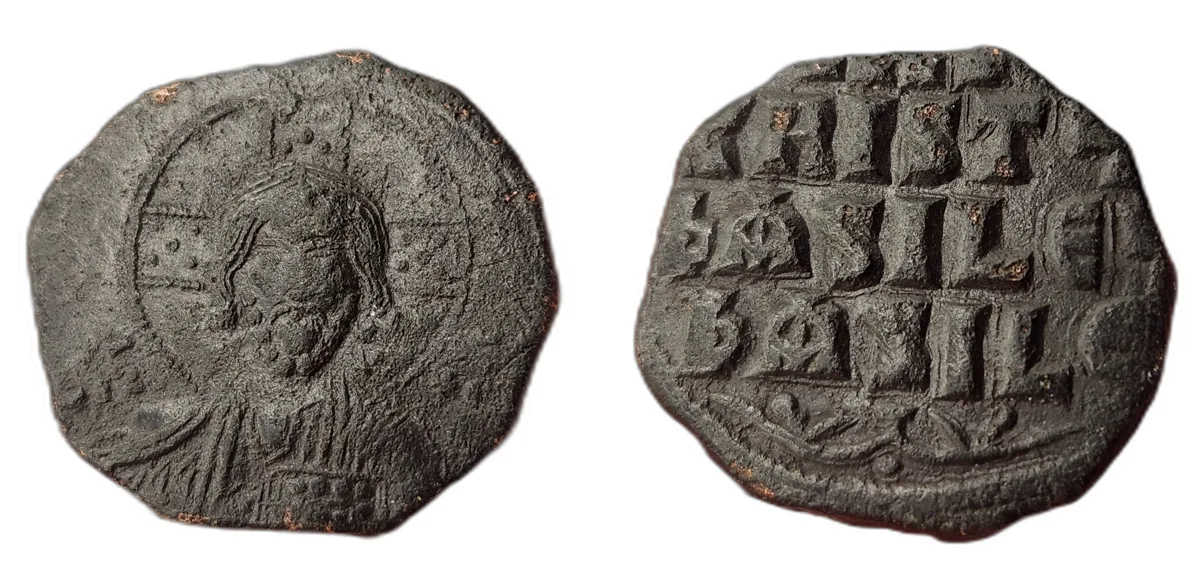
Anonymous Christ Follis (Class A3) — Basil II and Constantine VIII
Sold by NathanielsCreativeCollections
Description
Anonymous Follis (Class A3) — Basil II and Constantine VIII
Obverse: Facing nimbate bust of Christ Pantokrator, wearing pallium and colobium, holding Gospels with both hands, IC to left, XC to right
Reverse: +IhSuS / XRISTuS / bASILEu / bASILE ("Jesus Christ, King of Kings"), in four lines
Mass: 8 g
Diameter: 27.5 mm
This follis belongs to the anonymous bronze coinage first introduced under Basil II and Constantine VIII around 976 AD, so called because it bears no imperial name or portrait at all, replacing the emperor's image entirely with that of Christ. The obverse presents a facing, nimbate bust of Christ Pantokrator, dressed in the pallium and colobium and holding the Gospel book with both hands, flanked by the abbreviations IC and XC for "Iesus Christus." The reverse carries no ruler's name or title, only the four-line legend proclaiming Christ himself as "King of Kings," the phrase from which the "Class A3" designation derives among the several sequential varieties of this anonymous type. The edges of this example show clipping that occurred in antiquity.
The introduction of this Christ-centered, anonymous coinage marked a significant shift in Byzantine numismatic tradition, subordinating the emperor's own image to that of Christ as the true sovereign authority behind imperial rule. It proved remarkably durable, continuing in various classes for roughly a century after its introduction under Basil II, one of the Byzantine Empire's most militarily successful rulers, and his nominal co-emperor Constantine VIII, whose long reign together oversaw major territorial expansion, including the conquest of Bulgaria.