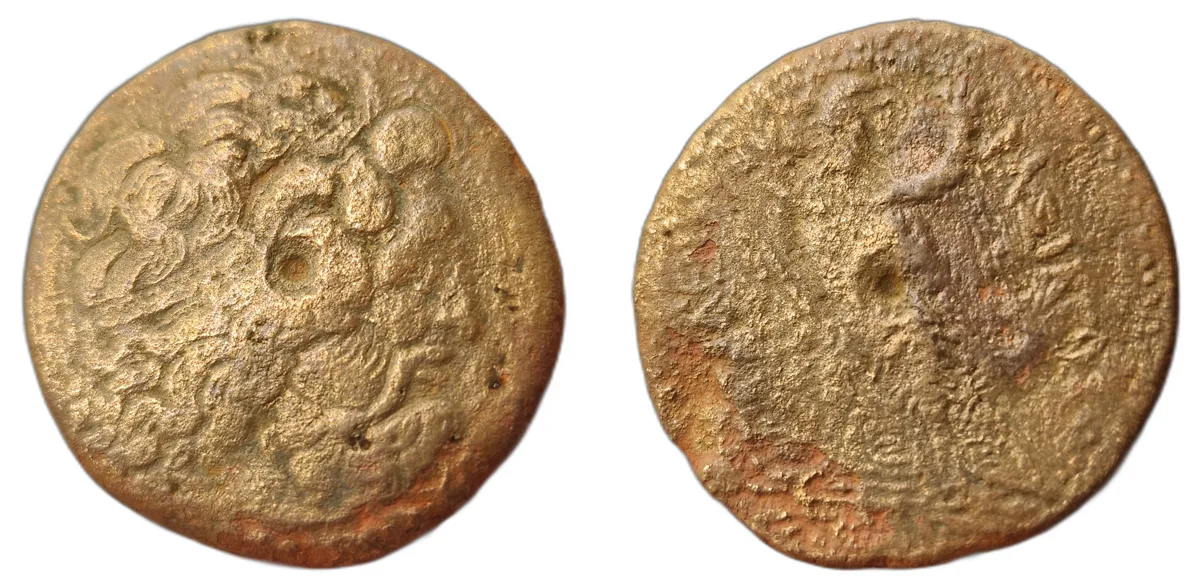
Ptolemy III Euergetes or Ptolemy IV Philopator - 39.17 g AE 37.5 - Tetrobol
Sold by NathanielsCreativeCollections
Description
Ptolemaic Egypt produced some of the largest bronze coins ever struck in antiquity. Under the Ptolemies, bronze denominations reached sizes far beyond anything typical of the Greek or later Roman world, with some issues weighing well over 100 grams. These massive bronzes served as practical, high-value currency within Egypt's relatively closed monetary system, while smaller denominations such as this tetrobol provided a more manageable form of bronze currency.
This tetrobol was struck at Alexandria between 246 and 205 BC, a period spanning the reigns of Ptolemy III Euergetes, who expanded Ptolemaic power to its territorial height through his victories in the Third Syrian War, and his son Ptolemy IV Philopator, whose reign saw the kingdom's fortunes begin to decline. The obverse depicts the diademed head of Zeus-Ammon facing right and wearing a taenia, linking Ptolemaic kingship with the divine authority of the syncretic Greek-Egyptian deity. The reverse shows an eagle standing left on a thunderbolt with its head turned right and wings closed, a cornucopia at the right shoulder, and an Epsilon between its legs, accompanied by the inscription ΠΤΟΛΕΜΑΙΟΥ ΒΑΣΙΛΕΩΣ ("of King Ptolemy"). The type's long production window makes a definitive attribution between the two rulers uncertain. It is catalogued as Svoronos 974, SNG Copenhagen 224–227, and Weiser 91.
Obverse: Diademed head of Zeus-Ammon right, wearing taenia
Reverse: Eagle standing left on thunderbolt, head right, wings closed, cornucopia at right shoulder, E between legs; ΠΤΟΛΕΜΑΙΟΥ ΒΑΣΙΛΕΩΣ ("of King Ptolemy")
Catalogues: Svoronos 974; SNG Copenhagen 224–227; Weiser 91
Mint Info: Alexandria, 246–205 BC
Mass: 39.17 g
Diameter: 37.5 mm